Anding Methodologies
Structuring the situation and problem our client is facing is already an important part of value creation. Most issues today are not being solved because their structure and underlying logic is not clear, not understood, not stable or simply not accepted and followed by relevant stakeholders


Anding brings a few powerful frameworks to help structure our clients’ challenges, communicate them clearly within the organization and devise clear paths to solving them.
These frameworks include:
These frameworks include:
Value Canvas
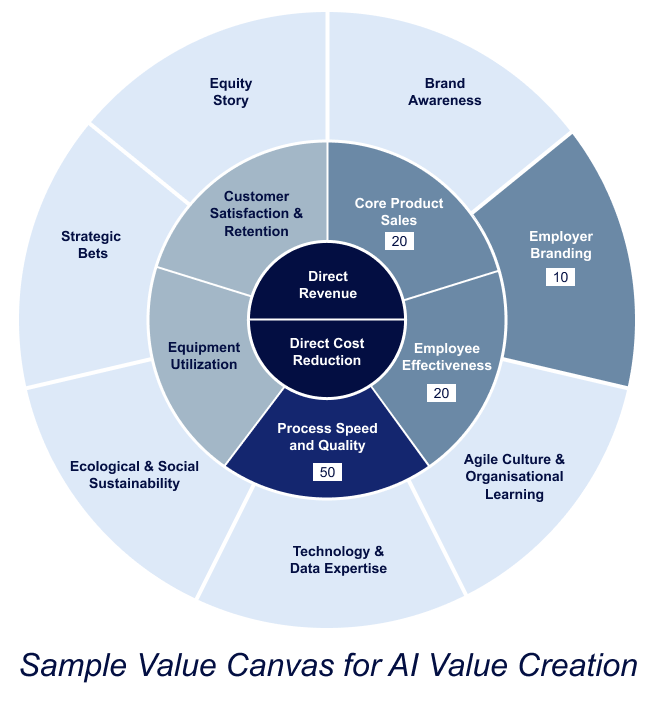
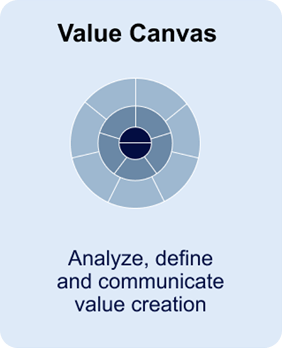
The Value Canvas is our signature framework to scope and communicate Value Creation with our clients — from Owner, to C-Level, to the whole team. We use it already at the beginning of our engagements to understand and align the leadership team’s often differing perspectives on areas of value to focus on. It plays a strong role in communicating this view throughout the organization and guides our value creation activities.
The Value Canvas SaaS solution is a great tool for effective interaction and value-interviews with our clients. A typical question to ask is: “Out of 100%, in which areas do you expect what amount of value to be created?”
Value Canvas Example: Anding value creation exercise is used by PE Funds and Portfolio Companies during the due diligence phase of a (potential) acquisition to ensure a coherent and aligned value creation plan, ready for execution.
The Value Canvas SaaS solution is a great tool for effective interaction and value-interviews with our clients. A typical question to ask is: “Out of 100%, in which areas do you expect what amount of value to be created?”
Value Canvas Example: Anding value creation exercise is used by PE Funds and Portfolio Companies during the due diligence phase of a (potential) acquisition to ensure a coherent and aligned value creation plan, ready for execution.
DIPOC
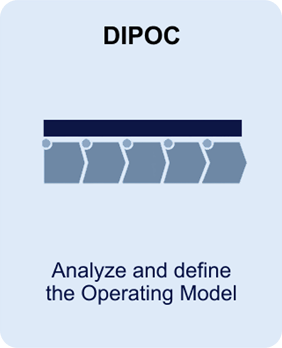
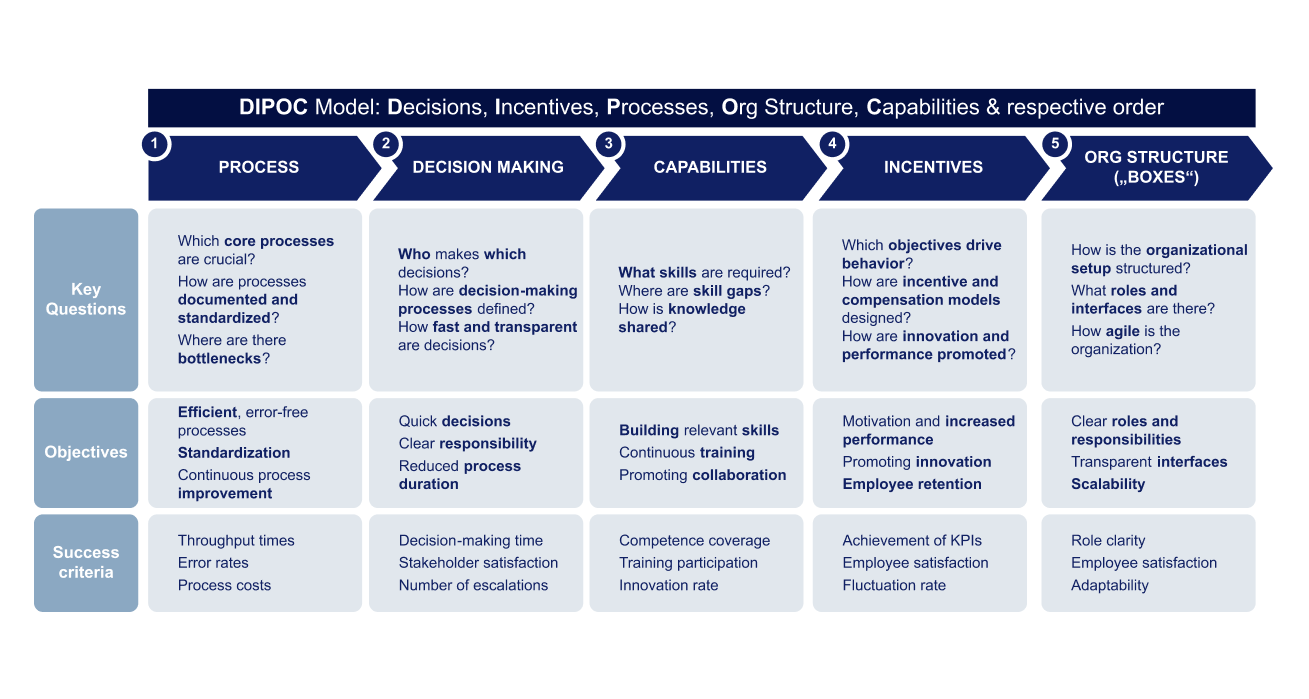
DIPOC is our Operating Model framework and is as widely used as the Value Canvas. It enables change within organizations by creating transparency (AS-IS and TO-BE) on Processes, Decision Making, Capabilities, Incentives and Organizational Structure (=PDCIO – or DIPOC for better usability). This logic gives our projects structure and helps us guide the client towards the required changes in their business.
It starts with Processes, redesigning end-to-end flows such as customer journeys or product development to embed digital logic and remove silos. Next come Decisions: clarifying who decides what, when, and at which level to ensure faster, data-driven execution. Capabilities are then assessed and developed — both technical (platforms, analytics, data) and organizational (skills, mindsets) — to enable the redesigned processes and decision logic. Incentives are aligned so that KPIs, rewards, and performance systems reinforce desired behaviors and adoption of digital ways of working. Finally, the Organization element adjusts structures, roles, and governance to sustain accountability, collaboration, and scalability.
By iteratively balancing all five levers, DIPOC turns (digital) strategy into an integrated, executable operating model.
It starts with Processes, redesigning end-to-end flows such as customer journeys or product development to embed digital logic and remove silos. Next come Decisions: clarifying who decides what, when, and at which level to ensure faster, data-driven execution. Capabilities are then assessed and developed — both technical (platforms, analytics, data) and organizational (skills, mindsets) — to enable the redesigned processes and decision logic. Incentives are aligned so that KPIs, rewards, and performance systems reinforce desired behaviors and adoption of digital ways of working. Finally, the Organization element adjusts structures, roles, and governance to sustain accountability, collaboration, and scalability.
By iteratively balancing all five levers, DIPOC turns (digital) strategy into an integrated, executable operating model.
OUTST
ANDING
PAIRAMID
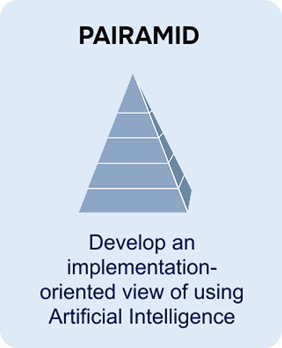
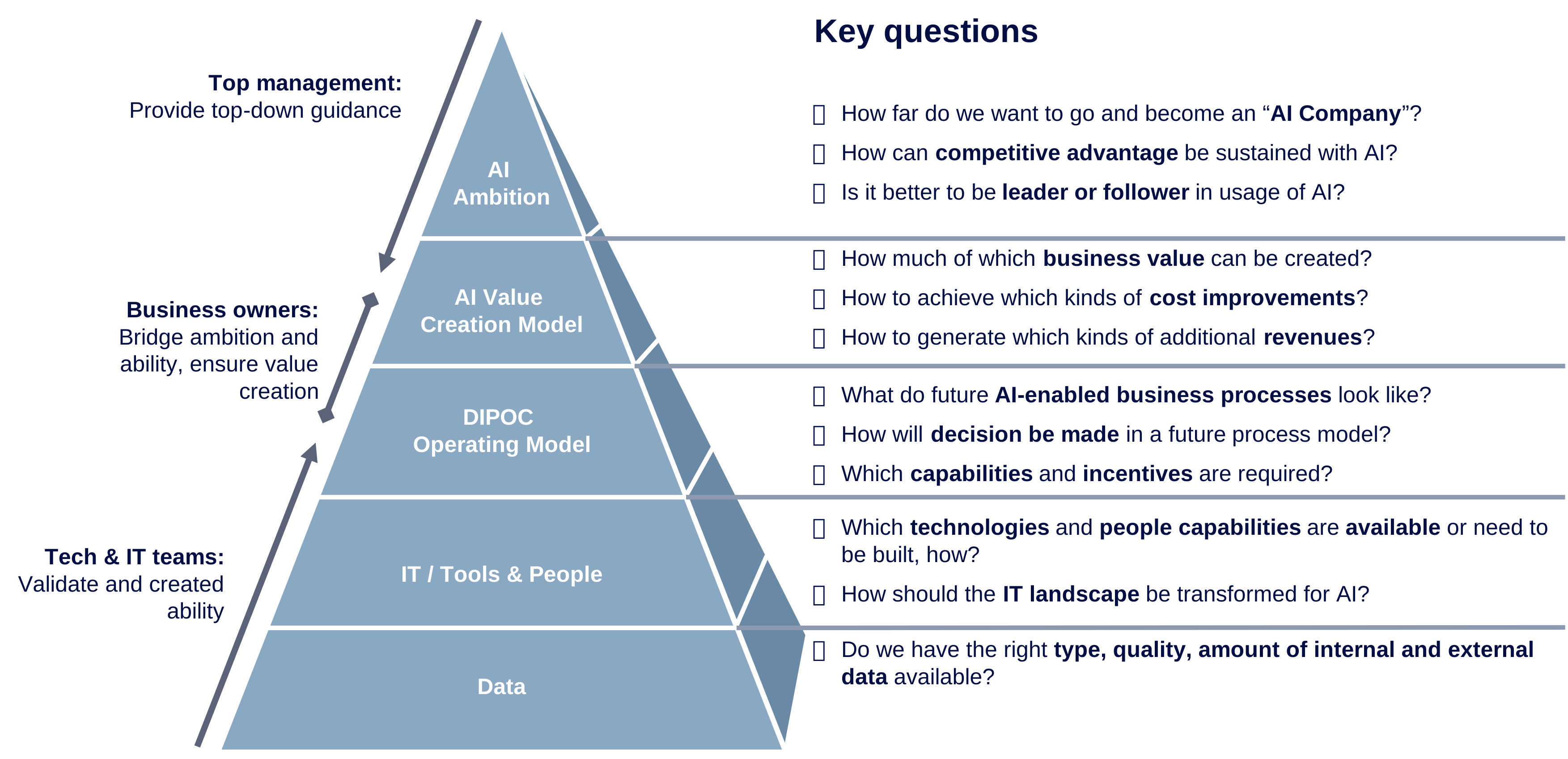
The PAIRAMID framework provides a structured way to operationalize AI by linking ambition, value creation, and operating model design. It guides organizations to define AI ambition (the degree of AI integration desired) and test it against value creation levers — reducing costs or boosting revenues through concrete, measurable use cases. Instead of abstract targets, it uses tools like the Digital Value Canvas to validate opportunities bottom-up.
The framework then embeds AI into the operating model by redesigning processes, decision rights, capabilities, incentives, and the organizational structure (via DIPOC) to sustain adoption. PAIRAMID is deliberately iterative: Ambition and technological feasibility are continuously reconciled, with pilots run to prove value. Unsuccessful use cases are dropped fast while scalable ones are amplified, ensuring AI deployment remains business-driven, disciplined, and sustainable.
The framework then embeds AI into the operating model by redesigning processes, decision rights, capabilities, incentives, and the organizational structure (via DIPOC) to sustain adoption. PAIRAMID is deliberately iterative: Ambition and technological feasibility are continuously reconciled, with pilots run to prove value. Unsuccessful use cases are dropped fast while scalable ones are amplified, ensuring AI deployment remains business-driven, disciplined, and sustainable.
Read our Thought Paper on AI
Hypothesis Tree
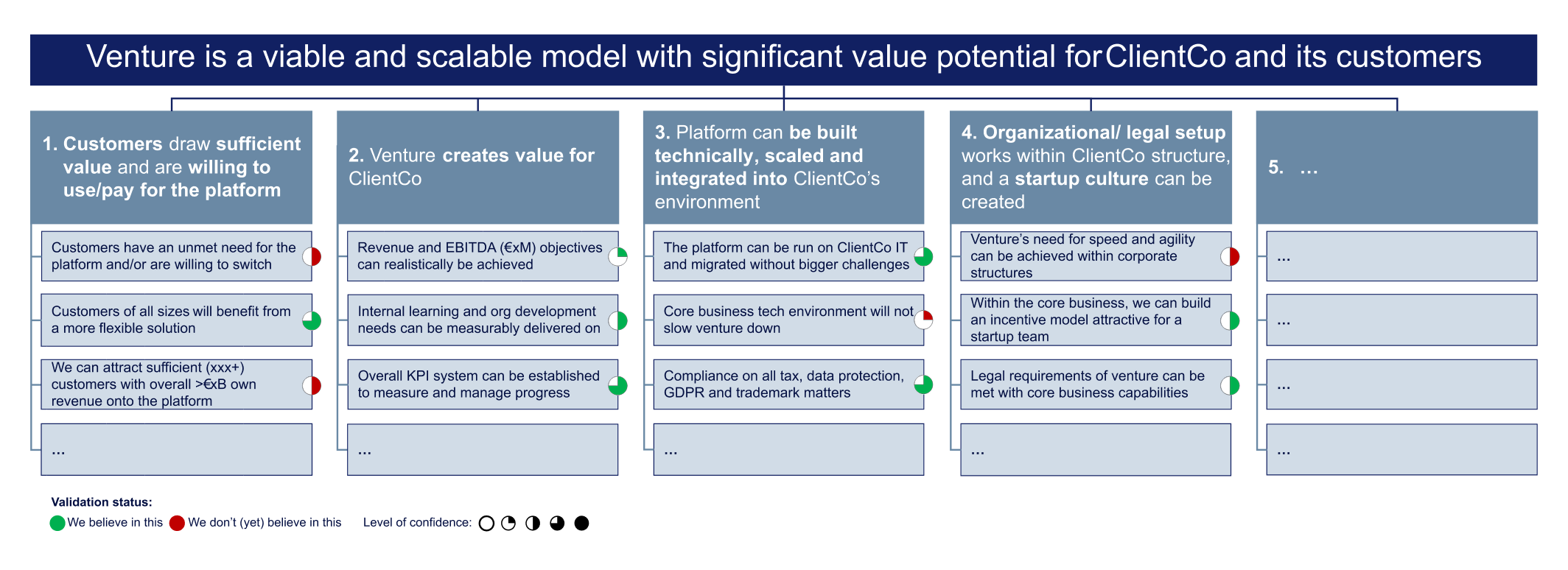
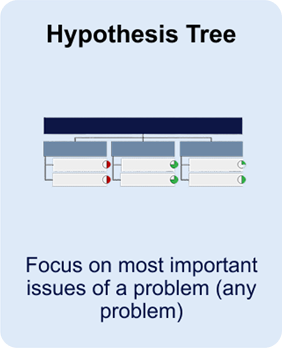
Not a unique concept and rather widely used in the consulting industry, the hypothesis tree helps structure hairy problems and focus problem solving on the most important questions and analyses. The key question to ask is: “What do we have to believe for this assumption to be true?” A typical main assumption in our business is “This corporate venture will enable us to create €50M in revenue and €15M in profits p.a. within 5 years.”
The hypothesis tree is a framework that is created by the Anding team at the start of every project to ensure we fully understand the problem and devise the main analyses to crack it accordingly.
The hypothesis tree is a framework that is created by the Anding team at the start of every project to ensure we fully understand the problem and devise the main analyses to crack it accordingly.